Lyft Driver
- 4.8
- Rating
- 5.00M
- Installs
- Free
- Price

 Analysis by App-foxy
I approached Lyft Driver as a working tool rather than a passenger app: something you open when you are deciding whether a few spare hours can become worthwhile driving time. That distinction matters. The app is built for people who want to drive with Lyft, and its entire flow is focused on getting from initial application to an active driving session. It is a free business app from Lyft, Inc., with an Everyone age rating, and it has built a strong audience with a 4.8 average from around 212 thousand ratings and over 5 million installs.
My overall impression is that the app makes the first steps feel approachable, but it does not remove the practical work around driving. You still need to think about vehicle readiness, documents, fuel, taxes, time, and whether the demand in your area makes a shift worthwhile. The application is useful because it puts the driver-facing process in one place, yet its value depends heavily on what happens outside the screen.
From deciding to drive to finishing a shift
Before I decide whether a driving shift fits into my day, I find it helpful to treat the app as one part of a larger routine, not as a promise that everything is ready at once. I’ll look at how the process moves from initial interest toward active work, and why setting a clear start and stop point can make that transition easier to manage.
You May Also Like

 Blood Strike: 2.5 Anniversary
Blood Strike’s Loadouts Turn Every Drop Into a Tactical Gamble
A close look at Blood Strike’s custom loadouts: how fast access to signature weapons reshapes its battle royale rhythm, rewards preparation, and narrows the gap between fights.

 Pandora - Music & Podcasts
Pandora’s Music Is Easy to Start, but Harder to Recover
Pandora’s strength is its low-effort path from a seed to a station. Its weak spot is how much confidence it asks you to place in connection, setup, and quiet recovery.

 8 Ball Pool
 Is Built on Rivalries, Rematches, and Routine
A close look at the rivalries, rematches, shared routines, and unanswered safety questions that turn a quick pool match into a persistent mobile community.

 Samsung Music
’s Quiet Strength Is Playing What You Already Own
Its reach comes less from spectacle than from dependable access to a personal library. That simplicity is both the app’s strongest retention engine and its ceiling.

 AccuWeather: Weather Radar
AccuWeather Review: A Quick, Clear Forecast for Everyday Decisions
For everyday plans, the best forecast is the one you can understand quickly. AccuWeather makes rain timing, radar, and local conditions easy to act on, with a few trade-offs.

 Hill Climb Racing
Why Hill Climb Racing Still Turns Crashes Into One More Run
A tiny car, a bumpy hill and one more upgrade: Hill Climb Racing keeps resurfacing because its simple chaos makes every near-miss feel personal.
More From Our News Desk



The starting point: turning spare time into a plan
The most realistic use case is not someone casually browsing an app store. It is a person looking at a free afternoon, an empty evening, or a changing work schedule and asking whether driving could fit. Lyft Driver speaks directly to that situation through its simple purpose: start the application process and move toward earning with Lyft.
I like that the app does not present itself as a general business-management suite. It is much narrower than that. The focus is driving, so the first question is practical: are you ready to apply and meet the requirements associated with driving in your area? That makes it easier to understand than an app overloaded with unrelated tools.
At the same time, the short promise of starting quickly should not be read as a guarantee that every person can begin immediately. The app can guide the process, but approval and readiness are separate from downloading it. A new driver should set aside time to work through the application carefully instead of treating installation as the finish line.
This is also where the app’s business category makes sense. It is not entertainment, navigation for ordinary trips, or a personal finance tracker. It is a work companion for a specific kind of independent driving activity. If you want a conventional employee scheduling app, a delivery platform, or a tool for managing a whole fleet, this is probably not the right starting point.
Working through the application without creating delays
The best way to use the app at the beginning is deliberately. I would keep the necessary personal and vehicle information close at hand, read each request rather than rushing through it, and check entries before moving forward. A small mistake in a name, address, vehicle detail, or document submission can create more friction later than it would have taken to review the screen properly.
That is one of the less obvious lessons with an onboarding app: speed is not the same as efficiency. Tapping through quickly feels productive, but a careful first pass is more likely to produce a clean handoff into the review process. I would also avoid beginning the application while distracted, such as between passenger trips or in a moving vehicle. The app is connected to a work process, so accuracy matters more than finishing in a few spare minutes.
Lyft, Inc. has kept the product’s purpose clear, which helps when the user is new to the platform. The current version is 2026.7.3.1772004233, and the app supports operating systems from version 9 onward. Those details are useful for anyone using an older phone, especially if the device is already responsible for navigation, calls, and other driving tasks.
One practical trade-off is that a phone capable of installing the app is not automatically a comfortable work phone. Drivers need to think about battery life, visibility, storage, mobile data, and how easily the device can be mounted without blocking the road view. Lyft Driver may be the central work app, but it shares the phone with everything else needed during a shift.
The handoff from application to active driving
The most important handoff is between the person completing the application and the platform reviewing it. This is where expectations need to stay realistic. The app can collect information and present the next actions, but the driver is still responsible for supplying accurate details and responding when something needs attention.
I would treat the application as a checklist rather than a one-time form. After submitting information, it is sensible to reopen the app and check for messages or requests before planning a first shift. That habit prevents a common mistake: assuming that silence means everything is finished.
Another handoff happens between digital readiness and physical readiness. Once a driver is able to work, the next step is not simply pressing a button and hoping for a good result. The car should be prepared, the phone should be charged, and the driver should know where they are willing to work. A few minutes spent deciding those boundaries can make the shift feel much less improvised.
For a person trying the platform alongside another job, this transition is especially important. I would begin with a limited test period rather than immediately reorganizing my entire week. A short, planned session can reveal whether the app fits the phone, whether the driving routine feels manageable, and whether the work suits the driver’s expectations.
What the working flow feels like
During the active part of the job, the app becomes the driver’s operational screen. The driver is no longer just completing an application; they are using a phone while managing real-world movement, passengers, traffic, and time. That changes how I judge the product. A clean interface matters, but so do glanceability and the ability to make decisions without unnecessary attention away from the road.
I would not use any driver app as something to study while moving. The safe workflow is to prepare before driving, make changes only when stopped, and keep the phone positioned where it can be seen without becoming a distraction. This is not a criticism unique to Lyft Driver; it is a basic condition of turning a phone into a workplace tool.
The useful outcome is a connection between the driver and Lyft’s trip workflow. The app is valuable when it reduces the gap between being available and knowing what to do next. It is less valuable when the driver expects it to solve every business decision automatically. The app can support the work, but it cannot decide whether a particular hour is profitable after fuel, maintenance, insurance, and unpaid waiting time.
That distinction is important for anyone attracted by the idea of earning quickly. I would track my own real costs separately, even if the app makes the driving process feel smooth. A busy screen or a steady sequence of trips does not necessarily equal a strong net result. The app handles the platform side; the driver still needs a personal method for judging the business side.
A realistic afternoon with the app
Imagine a driver who has finished a morning job and has a few hours before collecting a child from school. The driver opens Lyft Driver at home, checks that the phone is charged, confirms the car is ready, and decides on a clear stopping time. The goal is not to drive indefinitely; it is to use a defined window without allowing the shift to spill into the rest of the day.
Before leaving, the driver reviews the app and makes sure the account is ready for work. Once parked in a suitable place, the driver begins the session. During the afternoon, the phone becomes a prompt for the next part of the trip workflow, while the driver handles the physical responsibilities: safe driving, communication, finding suitable stopping points, and keeping track of time.
At the end, the driver stops rather than continuing simply because the app is still open. Back at home, the driver records fuel and other costs and compares the result with the time spent. That final step is easy to skip, but it is where the app’s promise meets reality. Without it, the driver knows activity, not necessarily earnings quality.
This scenario shows why I see Lyft Driver as a useful component rather than a complete business plan. It can help organize access to driving work, but the outcome depends on boundaries, preparation, and the driver’s own review after the shift.
Where the workflow breaks down
The onboarding flow can become frustrating when a user expects an instant start. A person may install the app during a moment of financial pressure and assume that the next step is immediate driving. In practice, application work, review, and preparation are different stages. The app’s clear purpose is a strength, but its simplicity can make the surrounding effort easy to underestimate.
Phone limitations are another weak point. Older hardware may meet the operating-system requirement yet struggle when several driving-related tasks compete for attention. A weak battery, poor visibility, or unreliable mobile connection can turn a straightforward shift into a stressful one. I would test the complete setup while parked before relying on it during a busy period.
There is also a personal-finance blind spot. Lyft Driver is not a substitute for a spreadsheet, bookkeeping app, or tax professional. A driver who wants detailed expense categories, long-term profit analysis, or broader business reporting may need another tool alongside it. That is not a reason to reject the app; it is a reason to understand its boundaries.
The work itself may also be the wrong fit. If you dislike unpredictable schedules, passenger-facing situations, vehicle wear, or the responsibility of staying alert for long periods, a driver platform will not become comfortable just because its app is easy to use. Someone seeking stable wages and fixed shifts may be better served by conventional employment.
How it compares with the usual alternatives
Compared with ordinary job boards, Lyft Driver is more direct for someone who has already decided to drive with Lyft. A job board helps compare many kinds of work, while this app concentrates on one path. That focus saves time for a prospective Lyft driver but makes it unsuitable for exploring unrelated opportunities.
Compared with a general navigation app, it is designed around the driver’s relationship with Lyft rather than simply getting from one address to another. Navigation software may be better for broader route planning or personal travel, while Lyft Driver is the more relevant place for the platform-specific work process. Many drivers may reasonably use both, because the jobs are different even when they appear on the same phone.
Compared with a personal bookkeeping tool, it offers a closer connection to the driving workflow but less flexibility for tracking an entire household or business. I would use Lyft Driver for the platform activity and a separate record-keeping method for fuel, maintenance, mileage, and time. Keeping those roles separate is more reliable than expecting one app to do everything.
Compared with another driving platform, the better choice depends on local demand, personal preference, and the terms available to the driver. I would not choose solely because one app has a polished application screen. The meaningful comparison is how well the complete routine works: onboarding, availability, trip handling, support, vehicle costs, and the ability to fit shifts around real life.
Who will get the most from it
Lyft Driver is a sensible choice for someone who already has a suitable vehicle, wants flexible driving work, and is comfortable handling the practical responsibilities of an independent driver. It is particularly useful for a person who wants one dedicated place to begin the Lyft driver process rather than searching through unrelated business tools.
It can also suit an experienced driver who wants a focused work app and does not need extensive accounting features built into the same product. The free price removes one barrier to trying it, although the real cost of driving remains outside the download itself.
I would be more cautious if you are applying only because the store summary sounds immediate. The app may help you get started, but it cannot promise that every application will move at the same pace or that every driving session will produce the result you want. A thoughtful trial, with costs and time recorded, is a better test than a single busy evening.
My conclusion after following the full workflow
After looking at the journey from initial interest to the end of a shift, I see Lyft Driver as a focused and practical entry point for driving with Lyft. Its strongest quality is clarity: the app knows what job it is meant to support. The audience response is also substantial, with around 48 thousand written reviews alongside its high average rating, which suggests that many users find the product useful in everyday work.
My recommendation comes with a condition: use it as part of a routine, not as the routine itself. Prepare before opening the app, check the application carefully, keep the phone safe to use while parked or mounted responsibly, and review your actual costs after driving. Those habits reveal whether the opportunity works for you far better than the download screen can.
For a person who wants a free, dedicated way to pursue Lyft driving, I would recommend giving it a fair trial. For someone seeking guaranteed income, full business accounting, or a fixed employment structure, I would look elsewhere or pair it with tools that cover those needs. In my experience, the app is at its best when it handles the platform handoff while the driver remains responsible for the decisions that determine whether the work is genuinely worthwhile.
FAQs for Lyft Driver
01What are the requirements to become a Lyft driver?
To become a Lyft driver, you need to meet several requirements, including being at least 21 years old, owning a smartphone, and possessing a valid driver’s license for at least a year. Additionally, you must have a clean driving record, pass a background check, and own a vehicle that meets Lyft's standards, which vary by location.
02How does Lyft protect the safety of its drivers?
Lyft prioritizes driver safety by offering features like in-app emergency assistance, 24/7 support, and the ability to share trip details with trusted contacts. Additionally, the app includes a rating and feedback system to ensure quality experiences, and Lyft provides insurance coverage during rides.
03How much can I earn as a Lyft driver?
Earnings as a Lyft driver vary based on factors like location, time of day, and demand. Lyft offers a base fare plus per-minute and per-mile rates. Drivers can also earn tips and bonuses, such as Prime Time pricing during high-demand periods. It's important to consider expenses like fuel and maintenance when calculating net earnings.
04What kind of support does Lyft offer to its drivers?
Lyft provides comprehensive support to its drivers, including 24/7 phone and in-app support for immediate assistance. The platform also offers an extensive Help Center with articles and resources. Additionally, drivers have access to community events and exclusive discounts on services like vehicle maintenance and insurance.
05Can I drive for Lyft if I already have another job?
Yes, driving for Lyft is flexible, making it ideal for those with other commitments. You can set your own hours and work as much or as little as you want, allowing you to balance Lyft driving with another job or personal responsibilities. This flexibility is one of the key benefits of being a Lyft driver.
Pros
- User-friendly interface enhances navigation.
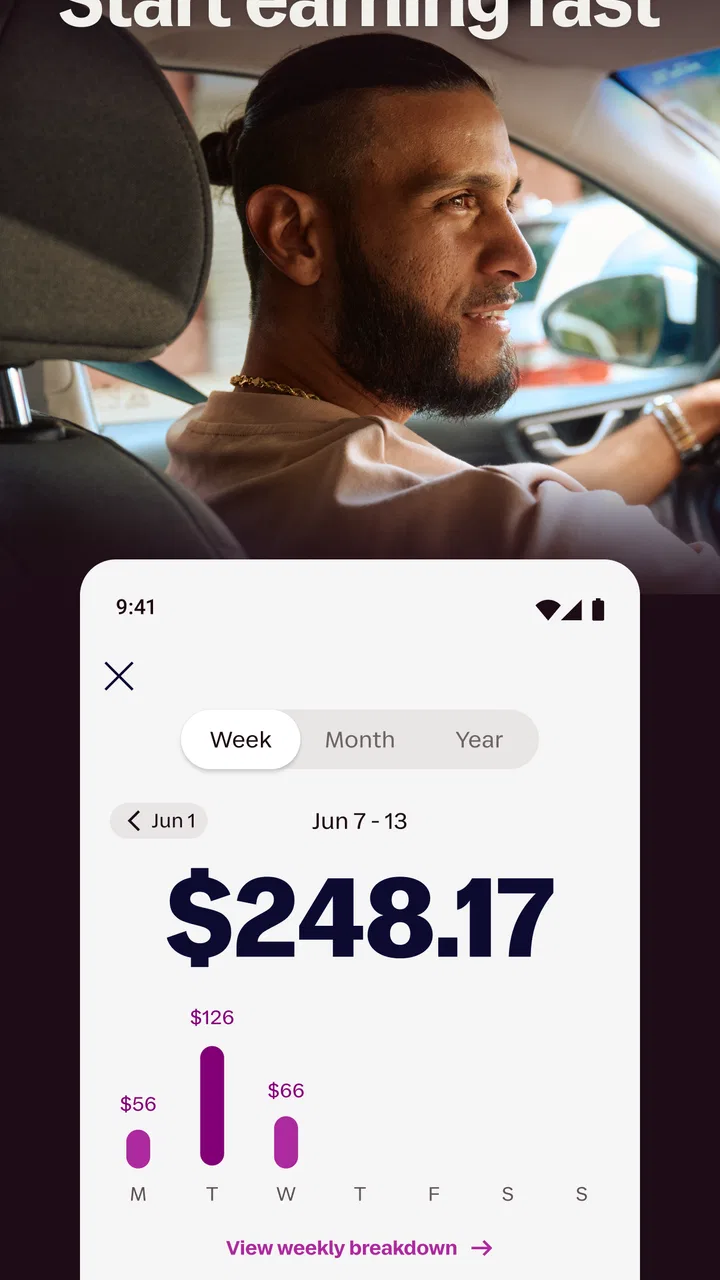
- Real-time earnings tracking for convenience.
- In-app navigation integrates seamlessly.
- Flexible driving schedule attracts drivers.
- Instant payout option available.
Cons
- High commission rates reduce earnings.
- App may occasionally freeze or lag.
- Limited customer support response time.
- Driver rating system can be stressful.
- Peak hours can be highly competitive.

Lyft Driver
Gallery